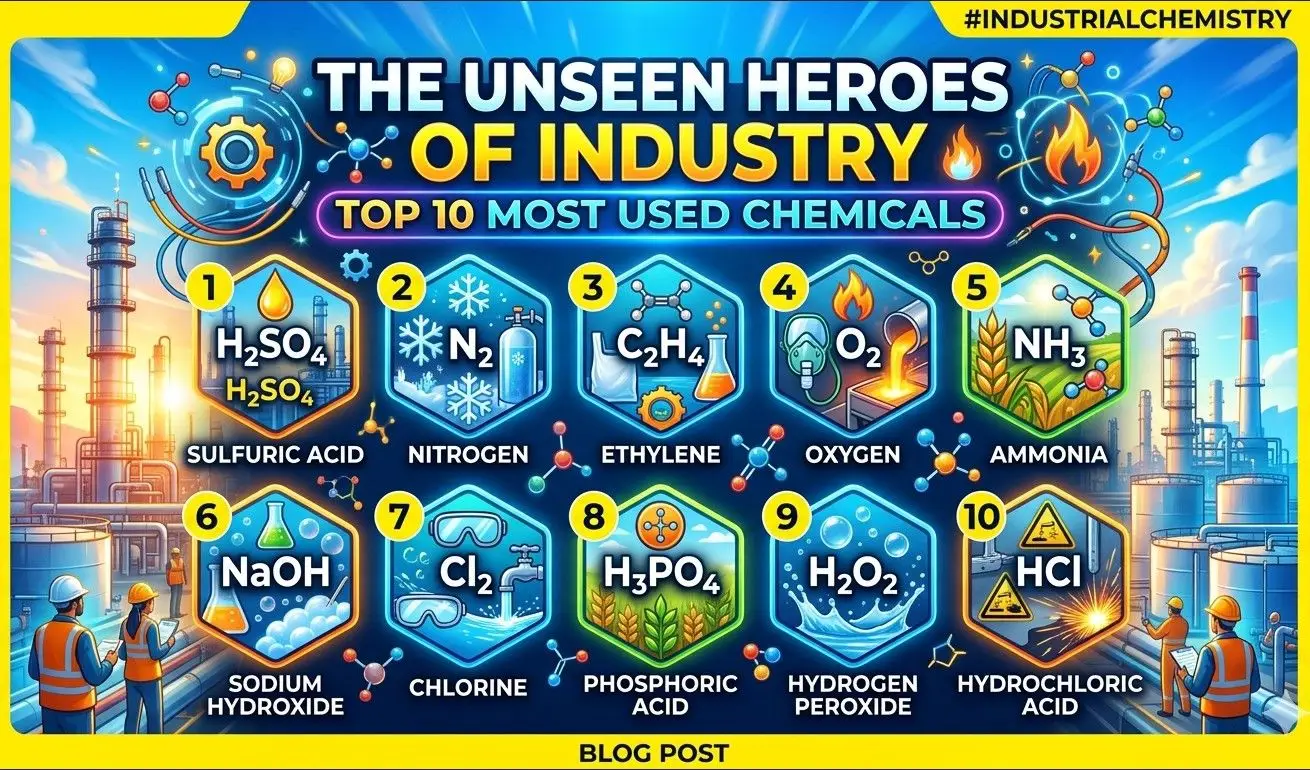
Deep dive into the Top 10 most heavily utilized chemicals in industrial applications, exploring what they do and why they are indispensable.
1. Sulfuric Acid ($H_2SO_4$)
Undisputedly crowned the “King of Chemicals,” Sulfuric Acid is the world’s most manufactured industrial compound. In fact, a nation’s industrial strength and economic health are historically measured by its sulfuric acid consumption.
- Primary Application: Fertilizer production. Over half of the world’s supply is used to manufacture phosphoric acid, which in turn creates phosphate fertilizers to sustain global agriculture.
- Other Key Uses: Metal processing (specifically steel pickling to remove rust), oil refining, chemical manufacturing, and the production of lead-acid car batteries.
2. Nitrogen ($N_2$)
While nitrogen gas makes up about 78% of the Earth’s atmosphere, industrial sectors require billions of tons of high-purity elemental nitrogen—both in gaseous and liquid forms—every year.
- Primary Application: Creating inert atmospheres. Because nitrogen is highly unreactive, industries use it to displace oxygen and prevent fires, explosions, or rapid oxidation.
- Other Key Uses: Blanket gas in oil refineries and chemical plants, flash-freezing food products, and preserving moisture-sensitive electronics during manufacturing.
3. Ethylene ($C_2H_4$)
Ethylene is the undisputed heavyweight of the organic chemical sector. It serves as the fundamental building block for the global plastics and polymer industry.
- Primary Application: Plastics manufacturing. Through polymerization, ethylene is transformed into polyethylene (PE)—the most common plastic in the world, used for everything from food packaging and grocery bags to industrial piping.
- Other Key Uses: Synthesis of ethylene glycol (automotive antifreeze), ethanol, and polyester fibers for textiles.
4. Oxygen ($O_2$)
Beyond sustaining life, pure oxygen is a fierce industrial workhorse. It is separated from air at massive cryogenic distillation plants to feed heavy industries.
- Primary Application: Steelmaking. In basic oxygen steelmaking, high-purity oxygen is blown into molten iron to rapidly oxidize and burn away impurities like carbon, silicon, and manganese.
- Other Key Uses: Oxy-acetylene welding and cutting, chemical synthesis (like producing ethylene oxide), and commercial wastewater treatment to accelerate biological purification.
5. Ammonia ($NH_3$)
Ammonia is a pungent gas that acts as a structural pillar for the global food supply chain, synthesized via the famous industrial Haber-Bosch process.
- Primary Application: Agriculture. Roughly 80% of all industrially produced ammonia goes directly into making nitrogen-based fertilizers like urea, ammonium nitrate, and ammonium phosphate.
- Other Key Uses: Industrial refrigeration systems (as an eco-friendly refrigerant with zero ozone depletion potential), manufacturing explosives, and formulating heavy-duty industrial degreasers.
6. Sodium Hydroxide / Caustic Soda ($NaOH$)
As a fiercely strong alkaline compound, Caustic Soda is the go-to chemical whenever an industry needs to neutralize acids, adjust pH, or drive a chemical reaction known as saponification.
- Primary Application: Pulp and paper manufacturing. It is used to cook wood chips, dissolving the unwanted lignin bonds to isolate pure cellulose pulp for making paper.
- Other Key Uses: Heavy-duty industrial cleaning, wastewater pH regulation, and saponifying fats and oils to manufacture soaps and commercial surfactants.
7. Chlorine ($Cl_2$)
Produced alongside caustic soda through the electrolysis of saltwater (the chlor-alkali process), chlorine is one of the most reactive and useful elements in the chemical inventory.
- Primary Application: Water sanitation. It is heavily utilized by municipal water treatment plants worldwide to destroy pathogenic bacteria, viruses, and algae in drinking water and sewage systems.
- Other Key Uses: Manufacturing Polyvinyl Chloride (PVC) plastics, synthesizing pharmaceuticals, and formulating industrial bleaching agents for textiles and paper.
8. Phosphoric Acid ($H_3PO_4$)
While less aggressively corrosive than sulfuric acid, phosphoric acid is a crucial mineral acid relied upon heavily by both the heavy agricultural sector and the food industry.
- Primary Application: Triple Superphosphate (TSP) and Diammonium Phosphate (DAP) fertilizer production, which provides crops with the essential phosphorus required for root development and energy transfer.
- Other Key Uses: Rust conversion treatments on iron alloys, food-grade acidulant in soft drinks (giving colas their signature tangy bite), and dental etchants.
9. Hydrogen Peroxide ($H_2O_2$)
Hydrogen Peroxide is celebrated as a premier “green chemical.” Because it is a powerful oxidizer that decomposes naturally into nothing but pure water ($H_2O$) and oxygen ($O_2$), it leaves behind zero hazardous chemical residues.
- Primary Application: Eco-friendly bleaching. It has largely replaced chlorine-based bleaches in the pulp, paper, and textile industries to whiten fibers without producing toxic chlorinated byproducts.
- Other Key Uses: Industrial wastewater detoxification, advanced oxidation processes (AOPs) to neutralize chemical spills, and high-level sanitization in food packaging lines.
10. Hydrochloric Acid ($HCl$)
Hydrochloric Acid is a highly corrosive, strong mineral acid. Its exceptional reactivity makes it the standard choice for aggressive chemical cleaning and pH control on a massive scale.
Other Key Uses: Regenerating ion-exchange resins in water purification plants, concrete etching for industrial flooring, and the chemical production of calcium chloride and polyurethane.
Primary Application: Metal pickling. Steel mills pass continuous sheets of carbon steel through hydrochloric acid baths to strip off iron oxides, scale, and rust before the metal is rolled, galvanized, or coated.