
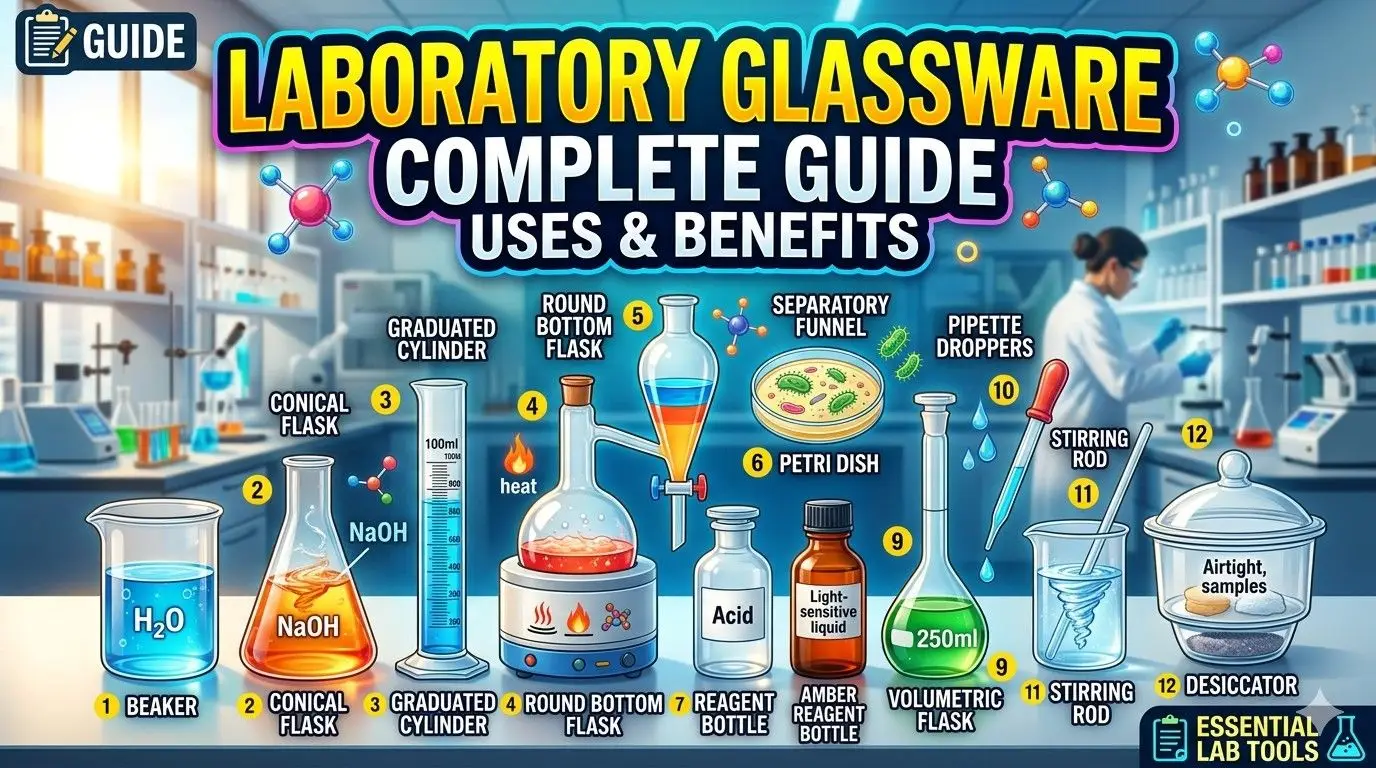
Step into any scientific research facility, chemical manufacturing plant, or academic laboratory, and you will be greeted by the glint of specialized glassware. Far from being ordinary glass, laboratory glassware is a collection of highly engineered precision instruments designed to withstand extreme thermal shock, aggressive chemical attack, and high-vacuum pressures.
Whether you are setting up a commercial chemical catalog, building an e-commerce storefront for laboratory supplies, or refreshing your foundational chemistry knowledge, this comprehensive guide breaks down the essential glassware pieces, their exact applications, and vital handling protocols.
The Standard Material: Why Borosilicate Glass?
Before diving into individual pieces, it is crucial to understand what makes lab glassware unique. The vast majority of professional laboratory glassware is crafted from high-purification borosilicate glass.
Unlike standard soda-lime glass used for kitchenware, borosilicate glass features a very low coefficient of thermal expansion. This unique molecular structure gives it two massive advantages:
- Thermal Shock Resistance: It can transition rapidly between high heat and cold baths without fracturing or shattering.
- Chemical Inertness: It possesses exceptional resistance to chemical corrosion, ensuring that strong acids, bases, halogens, and volatile organic solvents can be processed without leaching contaminants into the solution.
Essential Laboratory Glassware Breakdown
1. Beakers
The quintessential icon of the laboratory, the low-form beaker is a multi-purpose, wide-mouthed container with a uniform wall thickness and a precision-molded pour spout.
- Primary Uses: Holding raw materials, mixing solutions, executing basic chemical reactions, and heating liquids over hot plates or Bunsen burners.
- Key Feature: High-contrast graduated markings for quick, approximate volume estimations.
- Design Detail: Features a thickened, reinforced beaded rim to prevent chipping during frequent handling.
2. Conical Flasks (Erlenmeyer Flasks)
Invented by Emil Erlenmeyer in 1861, this flask features a distinctive flat, wide base that tapers uniformly up to a narrow, cylindrical neck.
- Primary Uses: Manual titrations, chemical reactions, and boiling or preparing microbiological culture media.
- Key Feature: The unique conical geometry allows for vigorous, continuous manual swirling and liquid agitation without the risk of splashing or spilling.
- Design Detail: The narrow neck is perfectly sized to accommodate rubber stoppers, corks, or sterile sealing films for sample storage and autoclaving.
3. Measuring Cylinders (Graduated Cylinders)
A tall, narrow cylindrical vessel specifically calibrated for liquid quantification. Unlike beakers and flasks, which only provide rough volume estimations, the measuring cylinder is a dedicated volumetric instrument.
- Primary Uses: High-precision volumetric measurement of fluids, chemical blending, and preparing accurate dilutions.
- Key Feature: High-resolution, permanent graduation lines (often silk-screened in durable blue or white enamel) for sharp visibility against both clear and colored solutions.
- Design Detail: Built with a heavy-duty round or hexagonal base to significantly lower the center of gravity, preventing accidental tipping on the workbench.
4. Round Bottom Flasks (RBF)
A heavy-walled, spherical flask designed specifically to distribute thermal and mechanical stress completely evenly across its entire surface area.
- Primary Uses: High-vacuum operations, standard or fractional distillations, rotary evaporation, and prolonged organic chemical synthesis under reflux.
- Key Feature: The spherical structure provides maximum physical resistance against implosions under vacuum and eliminates localized “hot spots” during intense boiling.
- Design Detail: Usually features precision-ground glass joints (such as 24/40) to guarantee completely airtight, leak-free connections with condensers and addition funnels.
5. Separatory Funnels
A conical, heavy-walled apparatus featuring a wide top opening and a sharply tapered lower neck equipped with a fluid flow control valve.
- Primary Uses: Liquid-liquid extractions, separating immiscible liquids of varying densities (e.g., isolating an organic solvent layer from an aqueous layer), and washing crude reaction mixtures.
- Key Feature: Crystal-clear phase visibility, allowing the operator to see the exact boundary line between two distinct liquids.
- Design Detail: Equipped with a high-performance, chemical-resistant PTFE (Teflon) or ground glass stopcock for ultra-precise liquid dispensing.
6. Petri Dishes
A shallow, cylindrical glass container that consists of a flat-bottomed dish and a slightly larger, loose-fitting overlapping lid.
- Primary Uses: Culturing microorganisms (bacteria, fungi, yeast) on agar media, seed germination studies, and observing crystal growth.
- Key Feature: Perfectly flat, distortion-free optical surfaces that allow for clean, unobstructed top-down or inverted microscopic monitoring.
- Design Detail: Built to withstand infinite cycles of high-pressure steam sterilization in autoclaves or hot-air ovens without clouding.
7. Reagent Bottles
Heavy-duty storage vessels engineered specifically to protect, preserve, and transport sensitive chemical inventories over long periods.
- Primary Uses: Long-term containment of concentrated stock acids, bases, standard solutions, and pH buffers.
- Key Feature: Available in crystal-clear glass for maximum visual monitoring, or UV-filtering amber glass to protect light-sensitive chemical compounds from photolytic degradation.
- Design Detail: Paired with an interchangeable, precision ground-glass stopper that forms an absolute vapor-tight seal to stop dangerous evaporation or atmospheric moisture ingress.
8. Pipettes (Droppers)
A classic, straightforward fluid transfer instrument consisting of a narrow, tapered glass barrel mated to a flexible, high-suction bulb.
- Primary Uses: Controlled, drop-by-drop liquid dispensing, analytical indicator addition during titrations, and micro-volume chemical sampling.
- Key Feature: Precision-molded, narrow tip designed to deliver uniform droplet sizes with minimal fluid retention inside the barrel.
- Design Detail: Completely inert glass construction prevents plastic leachable contamination, preserving solution purity.
9. Glass Stirring Rods
A solid, heavy-duty glass baton designed for direct physical contact with reactive liquid mixtures.
- Primary Uses: Manual chemical dissolution, breaking up stubborn precipitates, scraping residues from vessel walls, and guiding liquid pours from a beaker to prevent accidental run-off.
- Key Feature: Completely non-porous and non-reactive, ensuring zero chemical cross-contamination during aggressive agitation.
- Design Detail: Meticulously flame-polished on both ends to create smooth, rounded tips that protect thin-walled beakers and flasks from structural scratching.
10. Desiccators
A massive, thick-walled glass enclosure divided into an upper sample chamber and a lower desiccant chamber, separated by a perforated tray.
Design Detail: Features wide, finely ground glass flanges at the lid interface. When a thin layer of vacuum grease is applied, it forms a absolute airtight seal. (Vacuum models also feature a built-in top stopcock to accelerate drying under reduced pressure).
Primary Uses: Cooling hot crucibles to room temperature in a completely moisture-free environment before highly accurate gravimetric weighing, and preserving hygroscopic chemical powders.
Key Feature: Achieves a completely isolated, zero-humidity internal atmosphere.